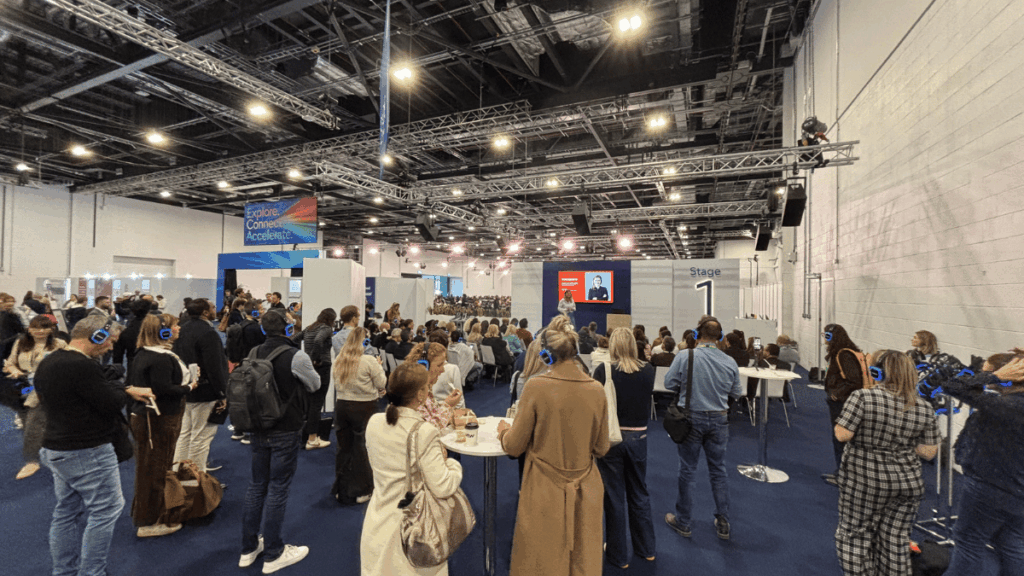
A consistent message, across two continents
Gartner HR Symposium 2026 brought together thousands of HR and L&D leaders this year — first in London, then in Orlando. Two cities, different time zones, different rooms. But anyone who attended both would have heard the same conversation playing out with striking consistency.
The conversations weren’t about which AI tools to deploy next. They were about something harder: what to do with the capacity AI creates, how to keep humans in control as agents take on more of the work, and whether HR has the strategic muscle to lead organizations through a transformation it’s being asked to run from the front.
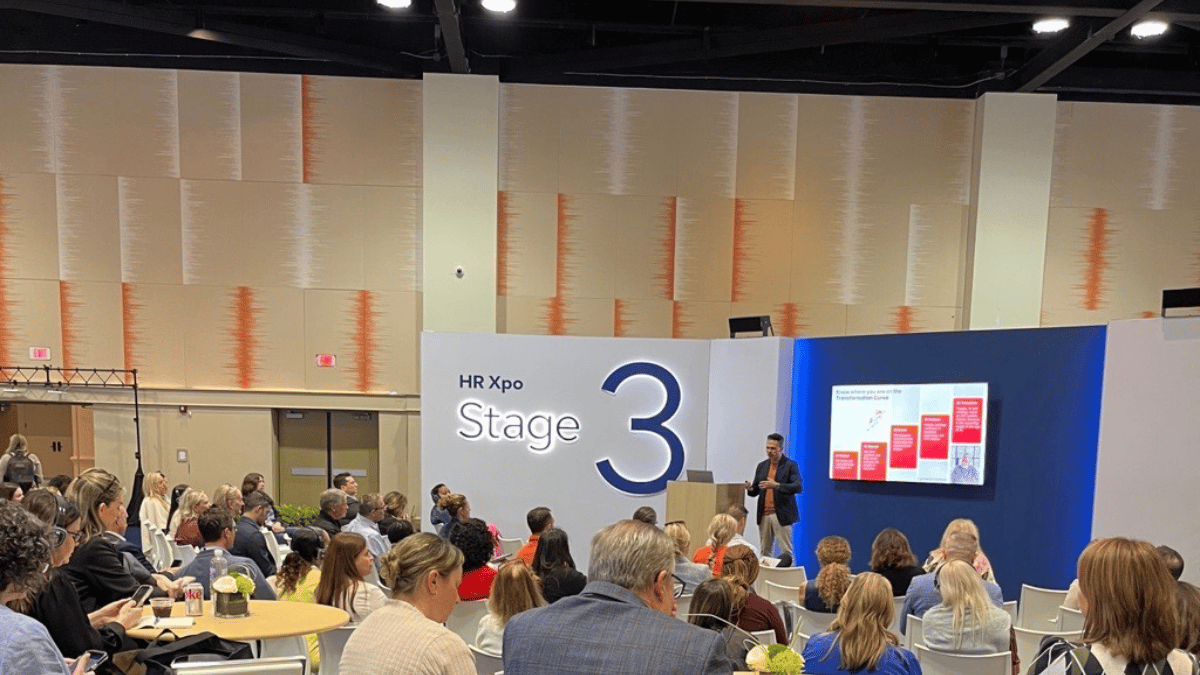
Zensai was present at both events. In London, Chief Human Success Officer Nina Carøe took to the stage with the question framing her session: What happens to performance after everyone has AI? While in Orlando, Chief Business Officer Robin Daniels asked a provocation of his own: If AI isn’t your biggest threat, what is?
Both sessions landed in the same territory the broader conference was exploring.
What the sessions told us: five themes that cut through
1. Productivity is the starting point, not the prize
Gartner Vice President Analyst Arj Bagga and Senior Director Analyst CV Viverito opened the main keynote — Productivity Isn’t the Prize — with a challenge to one of the most common boardroom assumptions: that AI is primarily a cost-reduction and productivity play. According to Gartner research cited at the event, around 77% of boards expect AI’s value to come from productivity and efficiency.
Yet the organizations seeing the strongest results are doing something different. They’re using work redesign to shift the cost of work, while redirecting AI gains into innovation. The organizations that do both are, according to Gartner, more than twice as likely to exceed cost goals and roughly four times more likely to outperform on revenue.
The keynote’s message was direct: time saved by AI doesn’t create value on its own. It disappears into more emails, more requests, more ambient busyness — unless someone makes a deliberate decision about where it should go. That decision is HR’s job.
It was also a question Nina Carøe put directly to her London audience in her Gartner EMEA session:
“AI can speed up work. That does not mean performance improves. The value appears only when we design for Humans and AI working together.”
2. Human skills matter more, not less
As AI takes on more procedural and knowledge-retrieval work, Gartner’s analysts identified a growing blind spot in hiring and development: human advantage skills. Creativity, adaptability, complex problem-solving, and sound judgment (none of which AI currently replicates) are being asked for less and less in job postings, even as their strategic value rises. Gartner research highlighted that the number of skills required per role is growing by nearly 5% per year, and that by 2030, around a third of the skills required for today’s jobs will have changed.
One of the sharper observations from Gartner HR Symposium 2026 came from Gartner’s warning about “cognitive surrender”: as AI handles more of the repetitive work people used to learn from, the developmental repetitions that build judgment simply disappear. One company featured in a session had recognized this and brought those repetitions back deliberately, using AI simulations so that new joiners could rebuild the learning loops automation had removed.
3. Adoption is a learning and change problem, not a technology problem
Across multiple sessions, the same pattern emerged: organizations that hand out AI tools without investing in learning, trust-building, and change support find those tools unused or underused. Gartner data presented at the event showed that roughly 40% of companies are already over budget on AI, and that this number is expected to grow. Meanwhile, most organizations measure AI adoption by usage rates (how many employees open the tool each week) without measuring whether any of that use is creating value.
The lesson practitioners kept returning to: define what you’re trying to change before you pick the tool, get a baseline measurement before you start, and treat the learning and change workstream as inseparable from the technology implementation — not a follow-on activity.
Robin Daniels, Zensai’s Chief Business Officer, made the same point in his Orlando session — and put it candidly:
“AI doesn’t fix your company. It exposes it.”
4. Human accountability for AI is unresolved — and the gap is growing
As AI agents move from assisting to acting, one of the most urgent conversations at the event was about ownership. When an AI agent makes a decision, or makes an error, who is responsible? Gartner’s analysts made the position clear: agents are not employees, and they are not accountable. Humans are. But in most organizations, the accountability architecture hasn’t caught up.
Gartner described three tiers of agent autonomy: from high-risk decisions where the agent recommends and a human stays in control, to high-volume routine actions where agents act independently with light oversight. The message for HR was practical: work with IT and legal now to define which decisions sit at which tier, and make sure managers are equipped to oversee work that mixes human employees and AI agents. Static RACI charts weren’t designed for this environment. They need to be replaced with something dynamic.
5. L&D has to earn its seat — or risk losing it
Gartner Senior Principal Analyst Liz Caffarelli’s session — Adapt or Obsolete: Reinventing Learning for Strategic Impact — was one of the most candid of the event. Nearly two thirds of HR leaders said skills are changing faster than learning can keep up. About half believe current learning solutions aren’t closing the skills gaps they exist to close. And roughly a third of L&D functions expect headcount reductions due to AI in the next 12 months.
The analysts’ argument wasn’t that L&D is obsolete. L&D needs to reinvent what it measures and how it operates. The shift: from measuring learning completions and activity, to measuring capability outcomes and business impact. From building content catalogs, to building something more fundamental: the organization’s ability to continuously learn and perform through human-AI collaboration. L&D is well-placed to lead that work. But it has to stop doing HR for HR’s sake and start from the business outcomes that get funded.

How HR can adapt by moving to a Human Success approach
The conversations in London and Orlando mapped closely to what we call the Human Success vision: the conviction that as AI takes on more of the procedural work organizations run on, the ability to develop, engage, and retain people becomes the defining competitive advantage. The more AI we have, the more human we need to be.
On reinvesting AI capacity
The keynote for the Gartner HR Symposium 2026 argued that productivity is the starting point, not the prize: freed capacity only creates value when it’s deliberately reinvested in people, growth, and innovation.
Zensai is built on the same logic. AI coaching inside the platform doesn’t just automate tasks; it gives managers the context they need to have better development conversations, and gives employees the personalized learning paths that align their growth to where the business is heading. The capacity that AI creates has somewhere to go.
On learning in the flow of work
One of Gartner’s consistent themes across both events was that learning has to meet people where they are, embedded in the work rather than separated from it. Zensai is engineered to live inside Microsoft 365 (Teams, Outlook, SharePoint, and Copilot), so that learning, engagement, and performance conversations happen where work already happens, not in a separate destination employees have to seek out. That’s not an integration. It’s the architecture.
On strategic skills building connected to outcomes
Gartner’s analysts noted that many organizations have invested heavily in skills taxonomies, only to find the frameworks underused once built. The challenge is activation: ensuring the right capabilities are prioritized, connected directly to business outcomes, and monitored continuously, rather than left sitting in a framework that never changes behavior.
Zensai’s approach to skills is built around exactly that: connecting roles to target skills, building learning paths based on actual performance data and individual career aspirations, and surfacing the capability signals that help HR and L&D leaders make strategic workforce decisions rather than reactively fill gaps.
On AI coaching that builds thinking
Perhaps the most resonant theme across both Gartner HR Symposium 2026 events was this: the value of AI in people development isn’t efficiency alone. It’s what happens when AI develops people rather than just processing tasks. Gartner was clear that agents are not accountable. Humans are. And the best AI deployments keep humans in control of the decisions that matter while taking friction out of the processes that don’t.
Zensai’s agentic AI coaching is built on exactly that principle. AI that prepares managers for every check-in and review. AI that coaches feedback quality, not just prompts for it. AI that surfaces the engagement signals that precede attrition, bringing them to the people who can act on them, with the context to do so. That’s coaching. Not suggestion. The distinction matters.
On human accountability and transparent governance
Analysts at Gartner HR Symposium 2026 made a point that Zensai’s architecture is specifically designed to address: in most organizations, AI operates outside the governance infrastructure IT has already approved, creating cost uncertainty, security questions, and accountability gaps. Zensai’s AI runs natively inside Microsoft 365, within the same security, governance, and compliance environment customers already operate in.
No additional security review. No separate cost meter. AI that’s contextual, governed, and included.

The signal worth carrying beyond Gartner HR Symposium 2026
But the through-line at both London and Orlando was simpler than that. The organizations making the most progress aren’t the ones with the most AI tools. They’re the ones that have decided where AI’s contribution to the business should go, and have built the human capability, the accountability structures, and the learning infrastructure to get it there.
As Erik Wahl — artist, author, and the event’s guest creative keynote speaker — put it in his session The Art of Vision: as you continue to automate, also humanize.
That’s the work. And it’s what Human Success is designed to support.
For the specific priorities Gartner is telling CHROs to act on before 2027, read the companion piece: Before 2027: The Four CHRO Priorities Gartner Says Can’t Wait.
And for a timely discussion on what good HR looks like in the age of AI, watch our conversation with CIPD: AI, People, and Performance: What Does Good HR Look Like Now?
Want to see how Zensai aligns learning, performance, and engagement with your organization’s strategic priorities? Book a conversation with our team.