

A new study analyzing 5,000 U.S. job postings has revealed the skills employers look for and value most, with high levels of communication, teamwork, and empathy topping the list.
The research, conducted by Human Success Company Zensai, assessed 5,000 of the latest US job postings collected from Glassdoor across all occupations, with no keyword or category filter applied. Of the postings collected, 4,997 (99.9%) contained usable description text to obtain the most desirable skills in employees. Each listing’s description text was scanned against a curated selection of traits, skills and behaviors, to determine what employers are seeking the most in their new hires and what they value among their own workforce.
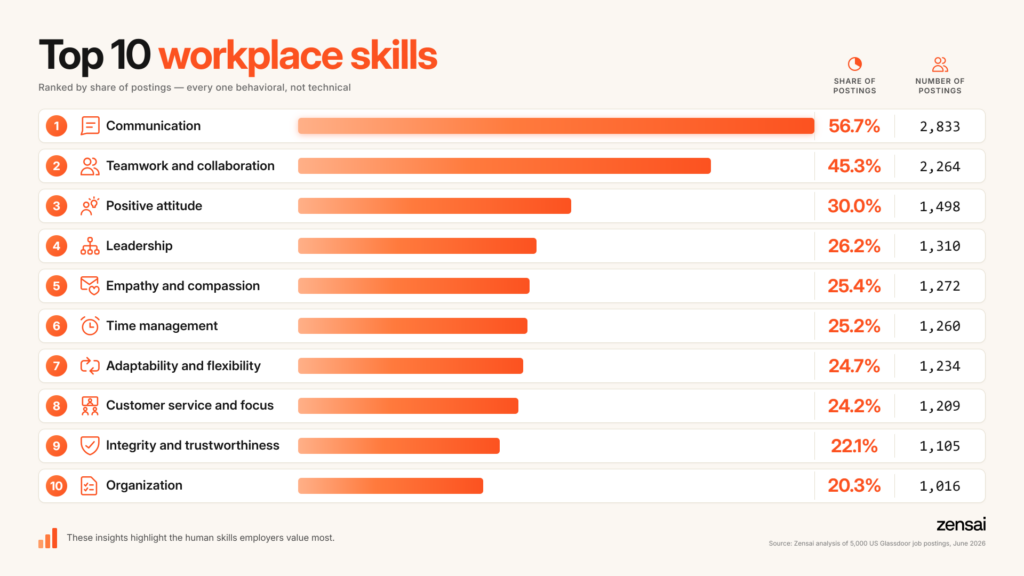
The study found that communication was requested in 56.7% of listings, ahead of teamwork and collaboration (45.3%), a positive attitude (30%), leadership skills (26.2%) and empathy and compassion (25.4%).
Every single trait in the top ten was behavioral rather than technical. In fact, the first hard skill, Microsoft Office/Excel proficiency, didn’t appear until 18th place.
As AI use is commonplace and integrated within companies, the focus appears to be less on behaviors about learning and attention to detail but more about having the right mindset and being able to work on projects effectively through collaboration.
Interestingly, less than 10% of job postings actually required a bachelor’s degree, with job ads favouring a positive attitude and experience over academic success.
What skills employers look for
Communication was named in 2,833 of the postings analyzed, making it the single most in-demand trait by a wide margin, followed closely by teamwork and collaboration. Notably, “positive attitude” ranked third, appearing in 30% of listings – a sign that employers are explicitly screening for outlook and resilience, above just experience.
The top ten most requested traits, skills and behaviors
Where hard skills and credentials rank
Behavioral traits dominate the overall list, however there are still several specific credentials and hard skills employers look for. Microsoft Office/Excel proficiency was the most requested hard skill, appearing in 11.9% of listings, while a bachelor’s degree was the most requested credential, named in 9.9% of postings.
Hard skills
| Rank | Skill | Share of Postings | Number of Postings |
| 1 | Microsoft Office / Excel | 11.9% | 595 |
| 2 | Computer literacy | 8.2% | 411 |
| 3 | Bilingual | 5.2% | 262 |
| 4 | Sales skills | 3.4% | 170 |
| 5 | Data analysis | 3.3% | 164 |
| 6 | Project management | 1.4% | 68 |
Credentials
| Rank | Skill | Share of Postings | Number of Postings |
| 1 | Bachelor’s degree | 9.9% | 495 |
| 2 | Driver’s license | 4.9% | 244 |
How are these skills maintained?
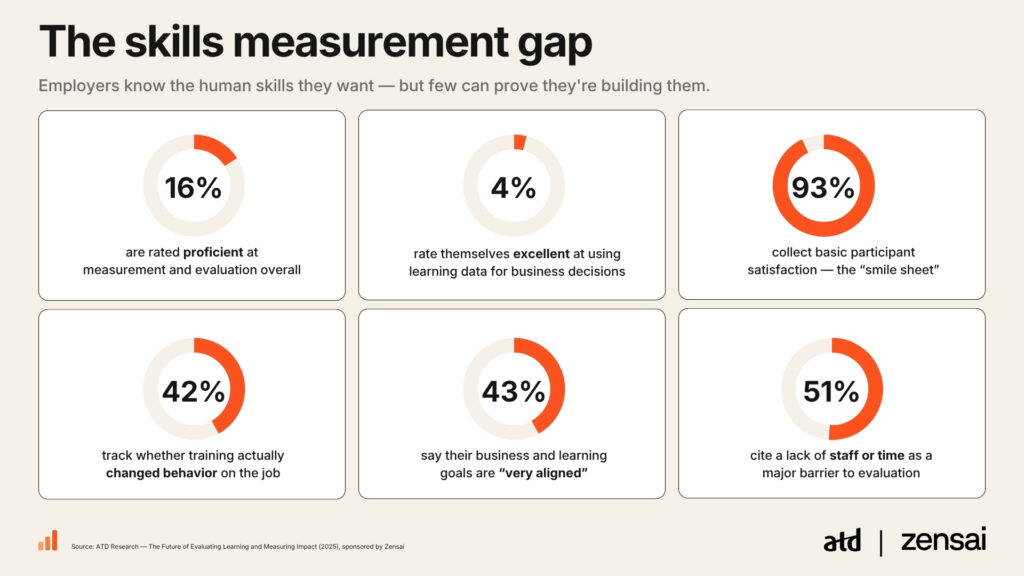
A study by The Association for Talent Development (ATD) and sponsored by Zensai, surveyed 277 talent development professionals and found that only 42% of organizations track whether training changes employee behavior, and just 16% are considered proficient overall at measuring and evaluating the impact of their learning programs. This suggests that while the human skills employers look for are clear, many still can’t demonstrate whether they’re successfully building them within their teams.
The survey of 277 talent development professionals found that 93% of organizations collect basic participant satisfaction data after training – the familiar “smile sheet” – but only 42% go further and track whether that training changed employee behavior on the job. In fact, just 30% rate themselves good or excellent at using learning data to make business decisions at all.
Over half of organizations (51%) cite a lack of staff and time as a major obstacle to evaluation, and 54% say it’s simply too difficult to isolate training’s impact on results from everything else going on in the business. Only 43% say their learning goals and business goals are even “very aligned” in the first place.
Measuring and evaluating skills employers look for
- 16% Organizations rated “proficient” at measurement and evaluation overall
- 4% Rate their organization excellent at using learning data to make business decisions
- 93% Collect basic participant satisfaction (“smile sheet”) data
- 42% Track whether training actually changed employee behavior
- 43% Say business and learning goals are “very aligned”
- 51% Cite lack of staff/time as a major barrier to evaluation
How does AI use impact this?
Many of the professionals surveyed are optimistic about where things are heading when it comes to AI. 81% of ATD respondents believe AI will have a positive impact on measuring and evaluating learning over the next two years, with 28% saying the impact will be “extremely positive.” Two in three respondents expect the pressure to demonstrate the financial return on talent development to increase, and 69% believe their organizations will need more employees with data analysis skills to keep up.
Nina Carøe, Chief Human Success Officer at Zensai, commented on the findings:
“What this study shows is that employers know exactly what they want from their people which is communication, and active collaboration, however, most organizations still struggle to measure these skills and improve them when the hire has come on board. Therefore, teams and business owners need to be conscious of using data and reporting to ensure that the skills, behaviors and values that they care about and benefit their businesses are being maintained and having an impact.”
Sources
Glassdoor; ATD (Association for Talent Development), The Future of Evaluating Learning and Measuring Impact: Improving Skills and Addressing Challenges (2025), sponsored by Zensai.
Methodology
The traits and skills data draws on 5,000 of the latest US job postings collected from Glassdoor across all occupations, with no keyword or category filter applied. Listings were gathered by sweeping approximately 150 US cities and de-duplicating by job ID. Of the postings collected, 4,997 (99.9%) contained usable description text. The median posting age at the time of capture was 24 days, and data was collected on June, 29 2026. Each listing’s description text was scanned against a curated lexicon of traits, skills and behaviors, with a listing counted once per trait group regardless of how many times it appeared.
The measurement and evaluation data is drawn from ATD Research’s survey of 277 talent development professionals, primarily based in the United States (92% of respondents), conducted between November 2024 and January 2025.